

What Is an Iron Condor?
| Tactic type | Defined-risk credit — neutral |
| Legs | Four — traded as two independent spreads |
| Thesis | Underlying stays inside a range |
| Minimum screen | 1:0.25 risk-to-reward — on each side separately |
| Live example | PLTR Jul-31-26 — $51 credit, $49 max loss |
An iron condor is the tactic retail traders hear about constantly and understand almost never. Four legs. Sold premium on both sides of the market. A payoff diagram shaped like a plateau with a cliff at each end.
Most explanations stop at the diagram. This one won’t, because the diagram isn’t the hard part — the management is. And the way TOPGUN Options manages an iron condor is different from what you’ll read on every other site: we don’t treat it as one four-legged structure. We treat it as two completely separate credit spreads that happen to share an expiration date.
That single distinction changes how you screen the trade, how you enter it, how you take profit, and how you handle it when the market moves against you. Below, the whole thing — including a live iron condor in Palantir with the actual order ticket.
Thirty tactics, one page each, with max profit, max risk, break-even and exit criteria spelled out. Plus the 7-Step Trade Plan we brief before any position goes on.
Send Me The ChecklistThe Four Legs of an Iron Condor
An iron condor is built from two vertical credit spreads placed around the current price of the underlying:
| Side | Structure | What it says |
|---|---|---|
| Bull put spread | Sell a put, buy a further-out-of-the-money put | “It won’t go below here.” |
| Bear call spread | Sell a call, buy a further-out-of-the-money call | “It won’t go above here.” |
If the first row looks familiar, it should — that half of the structure is a standalone tactic in its own right. We broke it down leg by leg, with a live Nvidia position, in our trader’s guide to the bull put spread. Everything in that article applies here, because on an iron condor the put side is a bull put spread.
The second row is a standalone tactic too — we cover it in full, with its own worked example and payoff diagram, in our guide to the bear call spread.
You collect a credit on both. If the underlying finishes between your two short strikes at expiration, every option expires worthless and you keep the entire credit. That’s the trade. It’s the same engine that drives a covered call — you are selling somebody else time and volatility — except here you’re selling it on both sides at once and you never have to own the stock. If you’d rather pay for a directional view than collect premium for a neutral one, that’s the other family: the bull call spread is the debit-side counterpart.
The long options on the outside are what make it defined risk. They cap what can happen to you. Without them you’re selling naked premium on both sides of the market, which is a different business entirely and not one we’re in.
The Football Trade
Look at the payoff diagram of an iron condor and you’re looking at a football field.
The live Palantir iron condor below, drawn to scale. The gold posts are the two short strikes — 119 and 128. Anywhere between them at expiration and every leg expires worthless.
Your short call and your short put are the uprights. The underlying is the football. And a football cannot split in half in midair and sail outside both uprights at the same time.
At expiration the underlying settles at exactly one price. It is either above your short call, below your short put, or between them. It is impossible for both sides to lose.
This is not a technicality. It’s the single most important thing to understand about the structure, because it tells you what your real risk is. You have two spreads on, but only one of them can ever be a losing spread at expiration. Your maximum loss is the width of one spread minus the total credit you collected — not the combined width of both.
If you want to compare this shape against the other standard structures side by side, Cboe’s Options Institute publishes the full set.
That’s expiration math. If you actively manage the trade — and we do — you can book a loss on one side, watch the market reverse, and book a loss on the other. The football didn’t split. You took one side off the field before the play was over. That’s a real cost of managing sides independently, and the discipline covered below is what keeps each of those losses small.
Why We Trade an Iron Condor as Two Spreads
Open any options textbook and the iron condor is presented as a single position with a single management plan. Put it on, hold it, close it.
That’s not how it gets traded on a desk, and it’s not how we teach it. An iron condor is a bull put spread and a bear call spread. Two trades. Two sets of numbers. Two decisions.
| Decision | Conventional | TOPGUN Options |
|---|---|---|
| Credit | One number for the structure | Tracked per side |
| Risk screen | Applied to the whole trade | Each side must clear 1:0.25 alone |
| Entry | All four legs, always | Leg in when the tape tells you to |
| Profit taking | Close the whole thing | Take each side when it earns it |
| Risk management | One exit for four legs | Evaluate the tested side on its own |
Screen the structure as a whole and you can carry a bad side without noticing, because the good side’s numbers are covering for it. Screen each side alone and the bad one has nowhere to hide.
The 1:0.25 Screen — Per Side
TOPGUN Options has a minimum risk-to-reward standard on every credit spread we place: 1:0.25. For every dollar at risk, we want at least a quarter back in premium.
On an iron condor, that test runs twice. The put side has to clear it. The call side has to clear it. If one side is paying you a tenth of what it’s risking, that side doesn’t go on — and neither does the condor, unless you re-strike it until it does.
Before we look at a single dollar of profit, we look at what this trade can do to us. If you’re not comfortable with the max loss, why are you concerning yourself with the profit? Every trade we place starts at the downside and works backward.
How We Enter: Legging In
Once you accept that a condor is two spreads, you don’t have to place them at the same moment. And much of the time, you shouldn’t.
The thesis is that the underlying stays in a range. But on the day you’re looking at it, price is usually doing something — drifting up, pulling back, or sitting still. Premium is always richest on the side the market is moving toward. So that’s the side we sell first.
| What price is doing | Fire this first | Why |
|---|---|---|
| Rallying, still range-bound | Bear call spread | Calls are bid — more premium for the same strikes |
| Pulling back, still range-bound | Bull put spread | Puts are bid — same logic, other side |
| Hanging out, going nowhere | All four legs together | No edge in waiting — put the whole thing on |
Then you wait for price to work back the other way and sell the second side into its premium expansion. Done well, legging in collects more total credit for the identical four strikes.
Done poorly, it leaves you sitting in a one-sided directional trade you didn’t intend to have. Which is why legging in requires a view — not a hope.
Legging in only pays when you expect price to keep working toward one side. If the move is already spent — the gap has filled, price has recovered off the lows, the selling is done — there is nothing left to wait for. At that point you are carrying execution risk for premium that isn’t coming. Put all four legs on and be done. The rule tells you which side is richer. Reading the tape tells you whether the move has anything left in it.
A Live Iron Condor: Palantir
Here is a real iron condor in Palantir Technologies (PLTR), placed July 28, 2026, with the actual order ticket and risk profile.
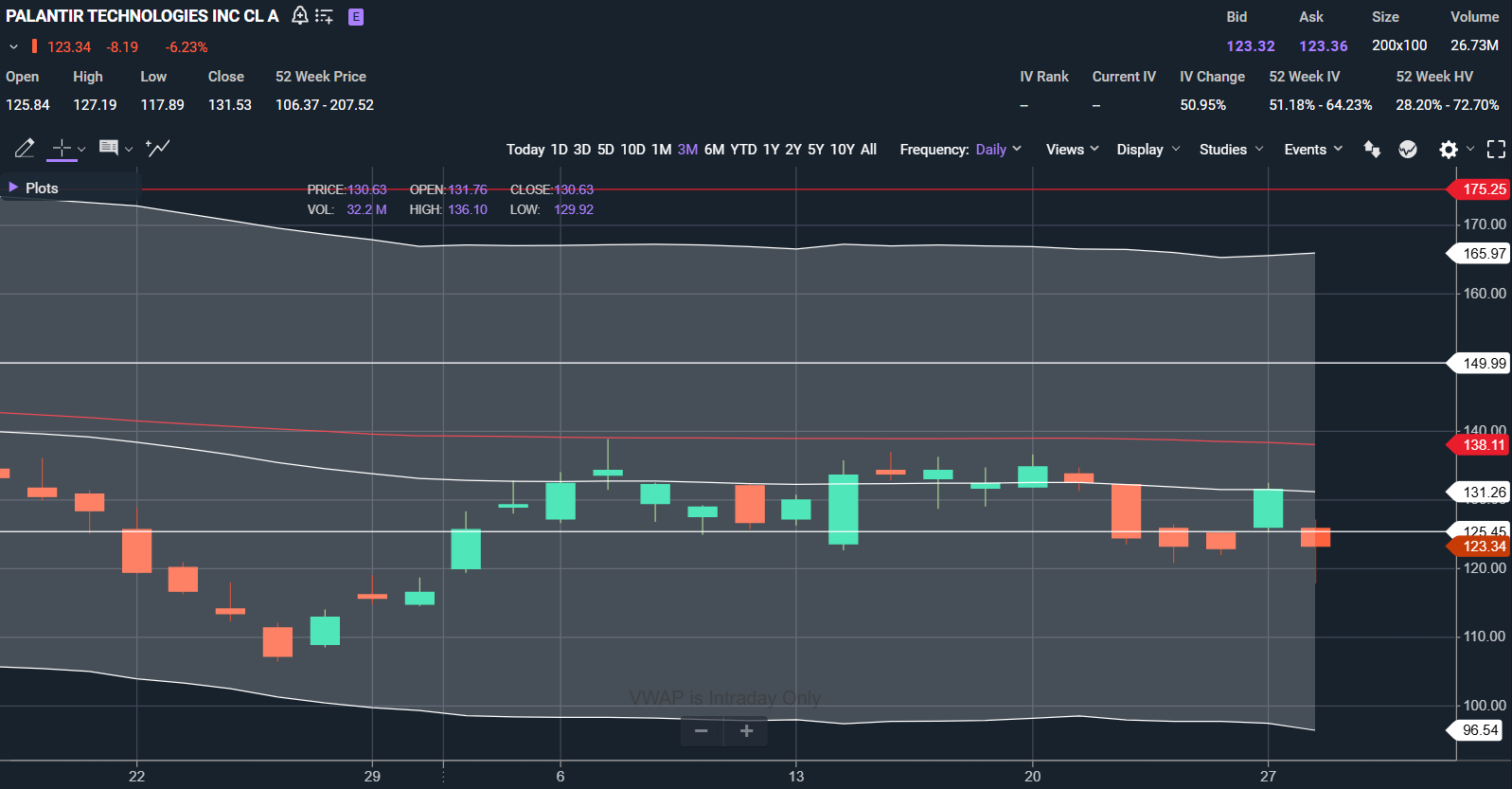
The setup. Palantir has spent weeks chopping between roughly $118 and $136 — no trend, just range. On this session it sold off hard, down more than 6% on the day, trading as low as $117.89 before recovering into the $123s. That kind of move is exactly what a range does: it tests an edge and comes back.
The thesis is not that Palantir goes up. It is not that Palantir goes down. It is that Palantir stays inside a box for three more days.
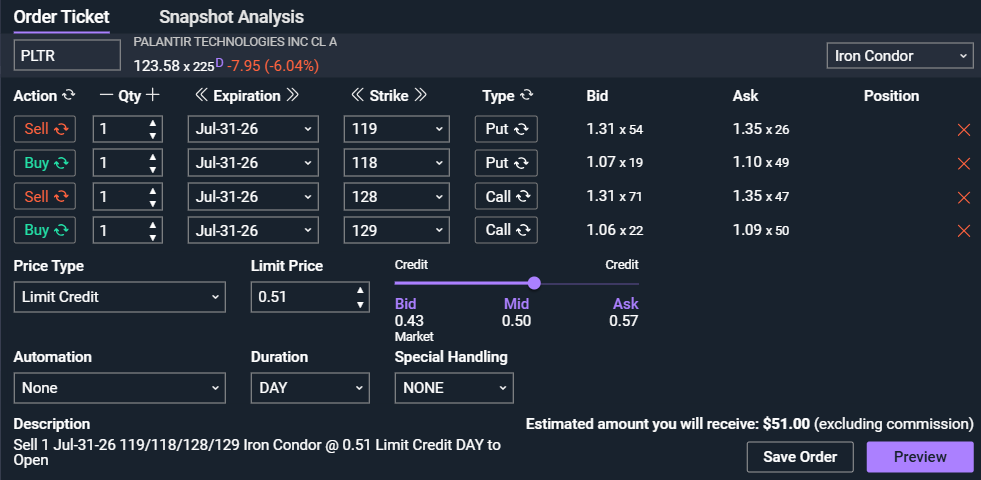
Why all four legs at once. The rule says a pullback means sell the put side first, into the richer premium. Not here. By the time this trade went on, the move had already done its work — the gap was filled, price had recovered off the lows, and the selling pressure was spent. There was no second wave to wait for and therefore no legging edge to capture. So the whole structure went on together, worked at the mid.
The Two Spreads
| Bull put spread | Bear call spread | |
|---|---|---|
| Structure | Sell 119 put / Buy 118 put | Sell 128 call / Buy 129 call |
| Width | $1.00 | $1.00 |
| Credit | ~$0.25 ($25) | ~$0.26 ($26) |
| Max loss, this side | $75 | $74 |
| Risk-to-reward | 1 : 0.33 ✓ | 1 : 0.35 ✓ |
| Warning light at | $0.50 | $0.52 |
Both sides clear the 1:0.25 screen independently. Neither one is being carried by the other. That is the test, and this trade passes it twice. Note that the put side here is structurally identical to the standalone Nvidia trade in our bull put spread guide — same construction, same screen, same warning light. The only difference is that on a condor it has a partner working the other side of the field.
The Structure
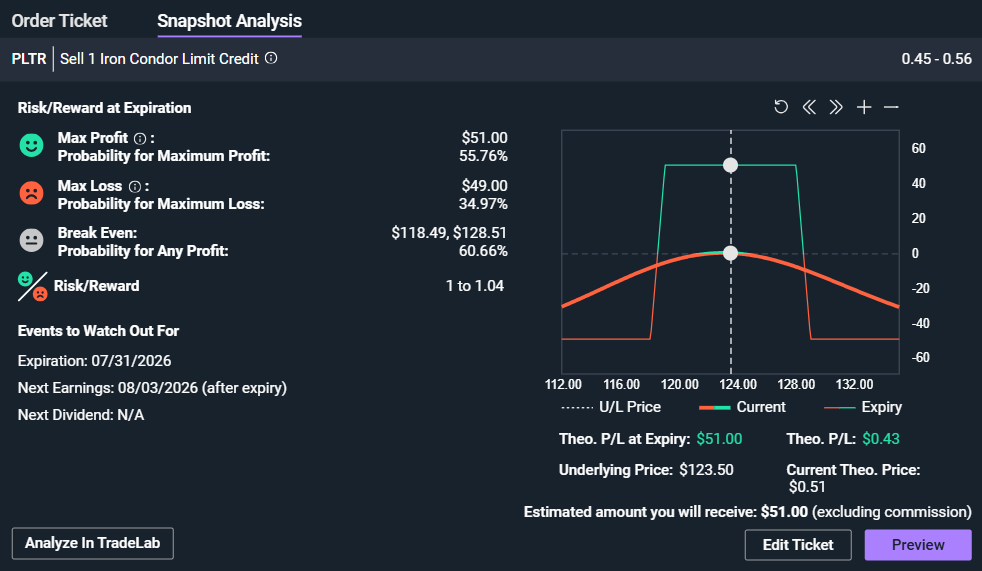
| Total credit collected | $51 |
| Maximum profit | $51 |
| Maximum loss | $49 |
| Breakevens | $118.49 and $128.51 |
| Expiration | July 31, 2026 |
| Earnings | August 3, 2026 — after expiry |
Why Max Loss Is $49 and Not $75
Here is the football principle in hard numbers, and it’s worth slowing down for.
Each side risks about three-quarters of a dollar. Two sides, so it looks like $149 of exposure. It isn’t. Total risk on this trade is $49.
Two spreads, $1.00 wide each — $200 of notional width. But the football lands on one side of the field. Only one spread can be at maximum loss when the buzzer sounds, and you keep the credit from both. One hundred dollars of width, minus the $51 you collected, equals $49.
Screened side by side, each spread is roughly 1:0.33. Screened as a structure, the trade risks $49 to make $51 — better than one-to-one. That gap is not an accounting trick. It is what the uprights pay you. The untested side’s credit is what shrinks the tested side’s loss.
The Earnings Decision
Palantir reports on August 3. This iron condor expires July 31. That is not a coincidence — it is the entire reason for choosing this expiration.
Implied volatility runs up into an earnings date. As a premium seller, that expansion is working for you: the options you sold are getting richer while the calendar grinds them down. Then, three days before the announcement, the position is closed and you are flat for the print.
Most retail traders do the opposite. They sell premium through earnings because the credit looks fat, and then discover what a binary event does to a $1-wide spread. Collect the run-up. Don’t be there for the release.
Trader In Command
I flew the F/A-18 Hornet. In that airplane I was Pilot In Command — PIC. Whatever happened on that flight, the decision was mine and the responsibility was mine.
In your account, you are Trader In Command. TIC. Nobody else is flying it.
Before every flight, fighter pilots brief contingencies. What could go wrong. What we do if it does. Not because we expect it — because when something happens at 400 knots, the last thing you want is to be thinking about it for the first time. You want to have already been there.
Trading is identical. You brief the contingencies before you put the trade on, so that when the position moves against you, you’re executing a plan instead of reacting to a screen.
When a credit spread reaches double the credit you took in, that is a flashing warning light in the cockpit.
It is not an automatic eject. It is a decision point. You look at the light and you evaluate: is this a brief spike the underlying recovers from, or is the thesis broken? If you believe the move is noise and the range holds, you don’t punch out. Maybe you eject. Maybe you don’t. That’s what situational awareness means.
Mechanical stop-loss rules feel safe because they remove the decision. They also guarantee you’ll be shaken out of trades that would have worked, over and over, by moves that meant nothing. The warning light tells you to look. What you do next is your call, because you’re the one in command.
On an iron condor, the light comes on for one side at a time — and the credit that matters is the credit on that side, not the total for the structure. On the Palantir trade above, the put side took in $0.25, so its light is at $0.50. The call side took in $0.26, so its light is at $0.52. Two positions, two lights, two decisions.
Taking Profit: The 7/8/9 Rule
We take credit spreads off at 70%, 80%, or 90% of maximum profit. The last few pennies are the most expensive pennies in the market — you hold days of risk to capture almost nothing.
On an iron condor, that rule runs per side. The untested side — the one price is moving away from — usually gets there first. Take it. That risk is now off the board permanently.
And then the answer to the obvious question: what do you do with the side that’s left?
Nothing changes. You are holding a credit spread, so you manage it exactly like a credit spread. Seventy, eighty, ninety percent and you take the profit. Double the credit you took in and the warning light comes on — and you evaluate, same as always. There is no special iron condor rule for the survivor, because there was never one position to begin with. There were two, and now there is one.
Bulls make money. Bears make money. Pigs get slaughtered. Holding a spread from 90% to 100% to squeeze the last nickel is how a winning month becomes a flat one.
What About Adjustments?
This is where the questions usually start. Rolling the tested side out in time. Rolling it down or up in strike. Widening the untested side to finance a repair. Closing one spread and re-selling it at different strikes when the underlying comes back into range.
All of it is real, all of it has a place, and none of it belongs in a single article — because the right adjustment depends on how much time is left, where implied volatility is, what your original thesis was, and whether that thesis is still intact. Adjustment is judgment, and judgment takes reps.
Nine sessions. A deep dive into the options tactics we use most — how they’re built, how they’re screened, how they’re managed, and how they get adjusted when the market doesn’t cooperate. This is the training, not the highlight reel.
Enroll in Options Weapons School →The AI Infrastructure Supercycle Report and the Bullish on ‘Merica SPX LEAPS Report land in your inbox instantly. The Psychedelic Biotech Sector Report follows by email. Institutional-grade research, no charge.
Get All Three Free →Want to Trade This Live?
Reading about an iron condor and watching one get placed in a live market are two different educations. Legging in, reading whether a move is exhausted, deciding what to do when the warning light comes on — none of that is learned from a payoff diagram. TOPGUN Options runs live trade briefs in two squadrons.
Solo AI covers ten names across the AI value chain — Palantir among them — with a live trade brief every Monday at 10:00 AM ET. The iron condor above is a Solo AI position.
Full Throttle runs two live trade briefs every week — the Primary Brief on Tuesday and Accelerated Retirement on Wednesday — plus Whiz’s model and personal portfolios and the Ready Room. It is the deepest look at how these positions get built and managed in real time.
Real positions. Real fills. Real management decisions as they happen — including the ones where the warning light comes on.
More free training on every tactic we run — spreads, synthetics, LEAPS and the rest — lives on the Learn Options Trading page.
“Trading is a form of combat. There’s a winner and there’s a loser. What side are you on?”
Fight’s On,
Matthew “Whiz” Buckley
CEO, TOPGUN Options | Wall Street Managing Director | TOPGUN Fighter Pilot | President, No Fallen Heroes Foundation | Founder, Sacred Warrior Fellowship


