

What Is a Covered Call Option?
Getting paid to own stock you already own — and what it actually costs you
A covered call option is the first income tactic most traders learn — and the one most of them run wrong. Here’s the mechanics, the real math, the five rules that keep it from costing you the trade you were right about, and a live position from our own book.
Get The Options Pocket Checklist — Free
Thirty tactics, one page each, with max profit, max risk, break-even and exit criteria spelled out. Plus the 7-Step Trade Plan we brief before any position goes on.
Send Me The ChecklistThe Mechanics — What You’re Actually Doing
A covered call option has two legs, and you probably already own one of them.
▶ Leg one: You own 100 shares of a stock. That’s the “covered” part — you hold the actual shares.
▶ Leg two: You sell one call option against those shares. Somebody pays you cash today for the right to buy your stock at a set price before a set date.
That cash is yours the moment the trade fills. It doesn’t matter what happens next — the premium is collected, deposited, and non-refundable. In exchange, you’ve agreed to a ceiling. If the stock rips past your strike price, your shares get called away at that strike and you don’t participate in a dollar of the move above it.
That’s the entire trade. Every covered call option is the same bargain: you are selling somebody else your upside, and they are paying you for it in advance. Whether that’s a good deal depends entirely on how much they’re paying and how much upside you’re handing over — which is where most people stop thinking, and where the actual work starts.
If the four positions underneath all of this are still new — calls, puts, buying, selling — start with options trading basics and come back. And if you like the idea of collecting premium but don’t own the shares, the defined-risk version is the bull put spread — same income engine, no stock required.
If you sell that same call without owning the shares, it’s a naked call — and your loss is theoretically unlimited, because the stock can go anywhere and you’d have to buy it at any price to deliver. Owning the 100 shares covers that obligation. That’s the difference between a covered call option and a naked one: same contract, completely different risk profile. Never confuse the two.
The Covered Call Option Math — A Simple Example
Round numbers make this concrete. Say you own 100 shares of a stock trading at $50 — a $5,000 position. You sell one call at the $55 strike, 45 days out, and collect $1.50 per share. That’s $150 in your account today.
| Stock at Expiration | What Happens | Your P/L |
|---|---|---|
| $40 | Call expires worthless, you keep shares | −$850 |
| $48.50 | Breakeven — premium covers the drop | $0 |
| $50 (flat) | Call expires worthless, you keep shares | +$150 |
| $55 | Shares called away at the strike | +$650 |
| $70 | Shares still called away at $55 | +$650 |
Look at the last two rows. At $55 you make $650. At $70 you make the same $650 — while the trader who simply owned the shares and sold nothing made $2,000. That $1,350 difference is the price of the $150 you collected up front. That is the entire trade-off in a covered call option, and it is not hypothetical. It happens every time you’re right about a stock and it moves hard.
Now look at the first row. At $40 you’re down $850 instead of $1,000 — the premium cushioned you by exactly what you collected, and not a dollar more. A covered call option is not downside protection. It’s a small discount on a loss you’re still taking.
When a Covered Call Option Actually Fits
The covered call option has one ideal condition and it’s narrower than most people admit: you’re neutral to modestly bullish on a stock you already intend to hold. You think it drifts sideways or grinds slightly higher over the next month or two. You don’t think it doubles.
▶ Good fit: A quality name you’ve held for years, in a consolidation range, where the premium is real money against a stock that isn’t going anywhere fast.
⚠ Bad fit: A name into earnings, into an FDA decision, into a takeover rumor, or in the middle of a breakout. Those are precisely the setups where you get called away right before the move you were waiting for.
⚠ Worst fit: A stock you’re bearish on. If you don’t want to own it, selling a call against it doesn’t fix that — it just means you own a falling stock with a coupon attached. Sell the stock.
Five Rules for Running It Right
1. Pick the strike you’d genuinely be happy selling at
Before you write the call, ask one question: if the stock closes above this strike and my shares disappear, am I fine with that outcome? If the honest answer is no, you picked the wrong strike — or you shouldn’t be selling a covered call option on this name at all. Assignment is not an accident. It’s the deal you signed.
2. Sell into elevated volatility, not into quiet
Option premium is priced off implied volatility. When fear is up, you get paid more for the same strike and the same duration. When the tape is dead calm, you’re handing over your upside for pocket change. Selling premium is a business — sell it when it’s expensive. Reading whether the tape is quiet or wild is its own skill; a Bollinger Bands read frames the question before you check the chain.
3. Respect the calendar
Time decay works in your favor as the seller, and it accelerates in the final weeks before expiration. That’s why the 30-to-45-day window is where most disciplined sellers operate. Go too far out and you tie up your shares for months while decay crawls. Go too short and you’re grinding for pennies and paying commissions to do it.
4. Know your earnings dates cold
Premium looks fat heading into an earnings report for exactly one reason: the market is pricing a big move. Writing a covered call option across an earnings date means collecting a fatter premium in exchange for accepting the highest-probability window for getting run over. Sometimes that’s a deliberate trade. It should never be an accident because you didn’t check the date.
5. Have an exit plan before you need one
If the call has lost most of its value well before expiration, buying it back to close cheaply frees your shares and takes risk off the table — you’ve captured the bulk of the premium without carrying the obligation to the finish line. If the stock is running at your strike and your thesis has changed, rolling the call up and out is a decision, not a panic. Make these calls in advance, in writing, not at 3:45 on expiration Friday.
Rules four and five are the ones that get abandoned under pressure — which is exactly why watching them executed matters more than reading them. Whiz runs two live trade briefs every week in Full Throttle, writing premium, rolling calls and closing positions with real money while members watch the decision get made.
A Live Covered Call Option — SBRA
Here’s how a covered call option looks on a name we actually hold rather than a textbook example. Sabra Health Care REIT (SBRA) is a position in our psychedelic sector book — and the reasoning has nothing to do with drug development.
The infrastructure thesis. Sitting with these medicines is not a fifteen-minute appointment. Supervised psychedelic therapy requires hours in a clinical setting with trained monitors present for the full duration — the FDA’s own finalized guidance for psychedelic trials expects two monitors observing each dosing session start to finish. You are not doing this on an exam table at your GP’s office on a sheet of wax paper. That means the sector needs physical treatment capacity: behavioral health facilities, clinic space, and the real estate underneath them. Somebody has to own those buildings. That’s the part of this trade nobody’s talking about, and it’s where SBRA sits.
Why it’s a covered call option name specifically. Go back to the ideal condition: a quality holding you intend to own, that grinds rather than gaps. A healthcare REIT fits that profile far better than a clinical-stage biotech does — the biotechs in this sector gap 60% on a takeout headline, which is exactly when you don’t want a ceiling on your position. SBRA doesn’t behave that way. And it carries roughly a 6% dividend yield, which means you’re stacking two income streams on the same shares: the premium you collect writing calls, and the dividend the REIT pays you for holding it. The stock doesn’t have to do anything for both to land in your account.
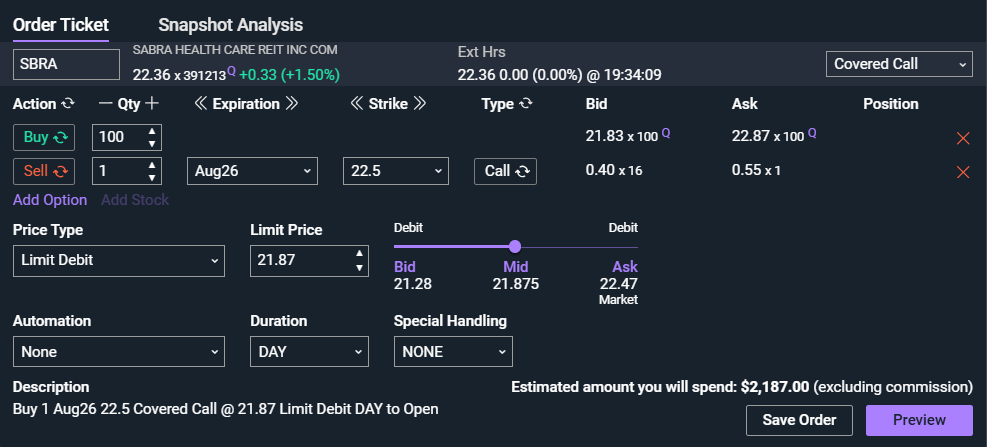
Buy 100 shares SBRA @ $22.36 · Sell 1 Aug26 22.50 Call @ $0.46
Net cost basis as staged: $21.87 per share — roughly $2,187 committed on the package.
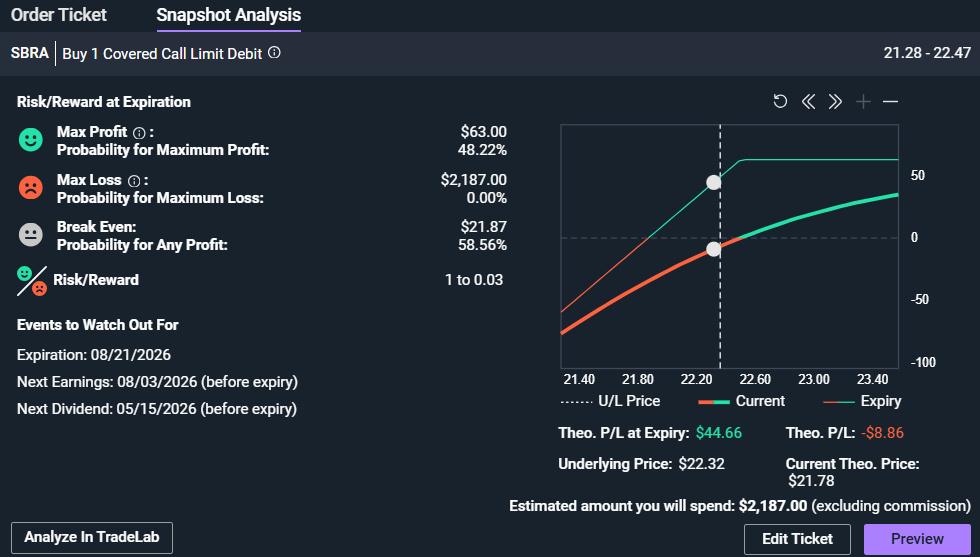
Run the same table on the real position:
| SBRA at Expiration | What Happens | Your P/L |
|---|---|---|
| $20.00 | Call expires worthless, you keep shares | −$187 |
| $21.87 | Breakeven — premium covers the drop | $0 |
| $22.36 (flat) | Call expires worthless, you keep shares | +$49 |
| $22.50 | Shares called away at the strike | +$63 (max) |
| $26.00 | Shares still called away at $22.50 | +$63 (max) |
Sixty-three dollars on $2,187 committed is 2.9% in under a month — and that’s before the dividend lands. Repeat that cadence on a name that keeps grinding sideways and the compounding does the work. The premium also drops your basis from $22.36 to $21.87, so the stock has to fall 2.2% before you’re underwater on the package at all.
Notice how tight that strike is. At $22.50 against a $22.36 stock, the call is only fourteen cents out of the money — nearly at-the-money. That’s deliberate. A closer strike pays a fatter premium and gives up more upside, which is precisely the right structure for a covered call option on an income name you expect to grind. Run that same tight strike on a biotech sitting on takeout risk and you’d hand away a 60% gap for forty-six cents. Same tactic, same mechanics, completely different decision — that’s rule one in practice.
Writing a covered call option on a dividend payer adds a mechanic that doesn’t exist on a non-payer: early assignment. American-style equity options can be exercised at any time before expiration — the full mechanics are laid out in the OCC’s Characteristics and Risks of Standardized Options. If your short call is in-the-money as the ex-dividend date approaches, the holder on the other side has a live incentive to exercise early and capture that dividend for themselves. You lose the shares and the dividend you were writing the call to complement — which defeats half the reason you picked the name. With a strike this close to the money, that’s not a theoretical risk. Know your ex-div dates, and think hard before leaving an in-the-money call open across one.
The Mistakes That Cost the Most
⚠ Treating it as a hedge. A covered call option isn’t one. The premium cushions a small move down and nothing more. If you actually need downside protection, you need a put — that’s a different tactic with a different cost structure, and it’s the floor we build into every synthetic stock position.
⚠ Chasing the biggest premium on the board. The fattest premiums sit on the names with the most trouble underneath them. You’re being paid more because the risk is higher. The market is not handing out free money.
⚠ Selling calls on your highest-conviction position. If a name is your best long-term idea, capping it for a monthly coupon is backwards. Write calls on the workhorses in the portfolio, not the thoroughbred.
⚠ Forgetting the tax consequences. Getting called away is a sale. That triggers a taxable event on shares you may have held for years at a low basis. Run that math before you write the call, not after.
A covered call option is a tool for generating income from stock you already own and expect to go nowhere in particular. It is not a hedge, it is not free money, and it is not something to run on autopilot across an entire portfolio. Used with discipline on the right names at the right time — a quality holding, a strike you’d be happy selling at, a dividend stacked underneath it — it’s a professional’s income tactic. Used indiscriminately, it’s a reliable way to keep all your losers and lose all your winners.
The full free library — credit spreads, condors, synthetics, LEAPS and the rest — lives on the Learn Options Trading page. Brand new to all of this? Start with getting started with options trading.
We Trade This Book Live.
SBRA and the rest of the portfolio get traded live in Full Throttle — the Primary Brief on Tuesday and Accelerated Retirement on Wednesday. Entries, exits, premium writes, and the reasoning in real time, plus Whiz’s model and personal portfolios and the Ready Room.
Go Full Throttle →Two Free Reports. Zero Cost.
The AI Infrastructure Supercycle Report and the Bullish on ‘Merica SPX Report — both delivered the moment you opt in. Real trade structures, real order tickets, and the reasoning behind every one of them.
Get Both Reports Free →“Trading is a form of combat. There’s a winner and there’s a loser. What side are you on?”
Fight’s On,
Matthew “Whiz” Buckley
CEO, TOPGUN Options | Wall Street Managing Director | TOPGUN Fighter Pilot | President, No Fallen Heroes Foundation | Founder, Sacred Warrior Fellowship


