

What Is a Bull Put Spread?
Getting paid to be right — and knowing exactly when to eject before you’re wrong
A bull put spread pays you cash up front to be modestly right about a stock. Here’s the mechanics, the math on a live NVDA position from our own book, and — before we ever mention profit — the risk screen and the eject rule that decide whether the trade happens at all.
Get The Options Pocket Checklist — Free
Thirty tactics, one page each, with max profit, max risk, break-even and exit criteria spelled out. Plus the 7-Step Trade Plan we brief before any position goes on.
Send Me The ChecklistThe Mechanics — What You’re Actually Doing
A bull put spread has two legs, entered as a single order, and it pays you the moment it fills.
▶ Leg one — sell a put at a strike below the current stock price. This is where the money comes from. You’re collecting premium for agreeing to buy the stock at that strike if it falls there.
▶ Leg two — buy a put at a lower strike. This costs you back part of that premium, and it is the most important leg in the structure. It’s your floor. It converts an open-ended obligation into a known, finite number.
The difference between what you collected and what you paid is your net credit — cash deposited on fill. Because money comes in rather than goes out, you’ll also hear this structure called a credit spread. Same trade, two names.
That credit is also your maximum profit. You will never make a dollar more, no matter how far the stock rallies. In exchange, your loss is capped too: the distance between the strikes, minus the credit you already banked. The stock doesn’t have to go up for you to get paid. It just has to not fall very far.
This structure has a mirror image. Flip it to the call side and you have a bear call spread — same defined-risk credit mechanics, opposite direction. Run both at once around a range and you have an iron condor. Everything on this page applies to the put side of that trade, unchanged.
Because a naked short put obligates you to buy 100 shares at the strike no matter how far the stock falls. On a $200 stock that’s a $20,000 obligation on a trade that might pay you fifty bucks. The long put costs you a portion of your credit and buys you a hard floor. You’re giving up income to buy certainty. On a defined-risk desk, that trade is not optional.
A Live Bull Put Spread — NVDA
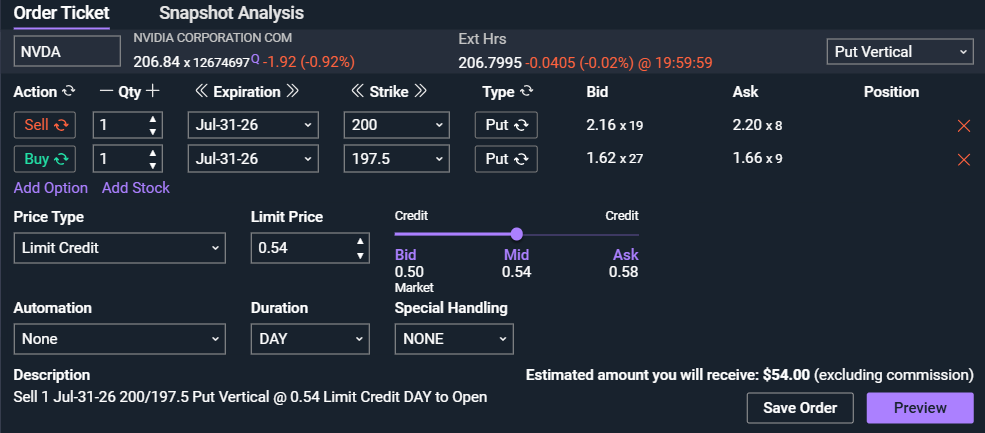
Here’s a real position rather than a textbook one. NVDA is trading at $206.84. We sell the July 31 200 put and buy the July 31 197.50 put for a net credit of $0.54.
Sell 1 NVDA Jul31 200 Put · Buy 1 NVDA Jul31 197.50 Put
Net credit: $0.54 — $54 collected on fill. Spread width: 2.50 points. Stock at entry: $206.84.
Step One: Maximum Loss. Always.
Notice we haven’t mentioned profit yet. That’s deliberate, and it’s the first thing we teach.
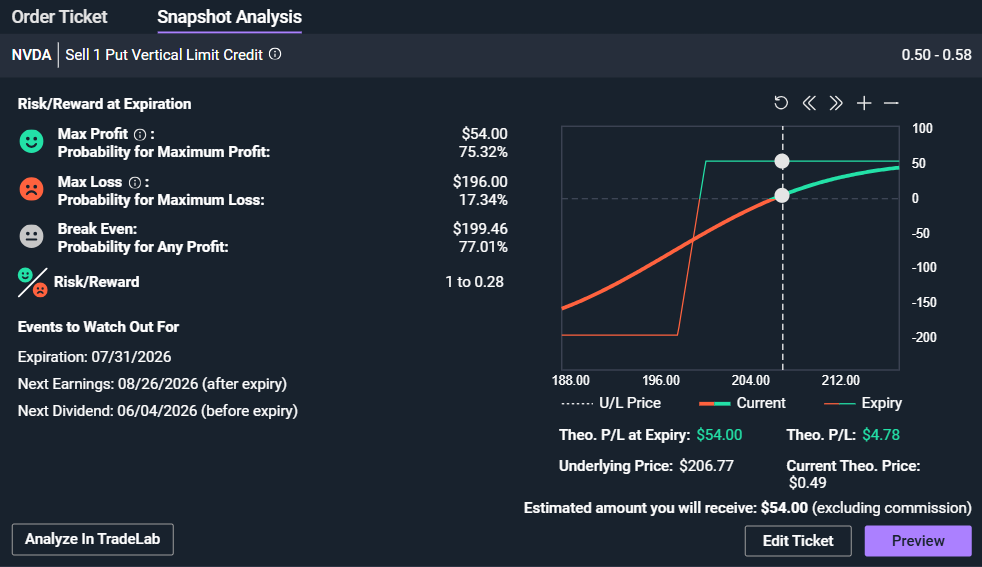
Maximum loss on this bull put spread is $196. The 2.50 spread width, minus the $0.54 credit already in the account. Floored by the long 197.50 put. NVDA could go to $120 overnight on a catastrophic headline and that number does not change.
Breakeven is 199.46 — the short strike less the credit. NVDA can fall 3.6% and this trade still comes out even.
If you’re not comfortable with the maximum potential loss, why would you even concern yourself with the potential profit? That’s the question. Look at max loss first, every single time. If the answer is “that number would hurt,” there is no trade to evaluate — you’re done, move on. Profit is irrelevant until risk has cleared.
Our standing rule on any credit spread: minimum risk-to-reward of 1 to 0.25. For every dollar at risk, we want at least twenty-five cents of credit. Below that, the math doesn’t justify the exposure and the trade doesn’t get placed.
This NVDA spread: $54 credit ÷ $196 risk = 0.28. Above the 0.25 floor. It clears the screen. Now — and only now — we’re allowed to talk about profit.
Here’s where we stop in the live brief. Still no talk of profit.
You took in $0.54. Double it. That’s $1.08. If this spread ever trades at $1.08, the position has moved against you by exactly the amount you stood to make — and that’s where you evaluate ejecting.
Buying it back at 1.08 costs $54. One max profit. Against a theoretical max loss of $196, you’ve capped the real damage at roughly 28% of it. A trade that looks like it’s risking $196 to make $54 becomes, in practice, close to one-to-one — because you never let it run to the wall.
It’s a simple rule of thumb that works on any credit spread, any underlying, any market. Take your credit, double it, write the number down. That’s your line — and it was drawn before a dollar was at risk.
Read back what just happened. We covered the structure, the maximum loss, the risk screen, and the exit — and we still haven’t celebrated a single dollar of profit. We are already contingency planning.
That’s the entire difference between professionals and everyone else. Amateurs enter thinking about what they’ll make. Professionals enter having already decided what they’ll do when it goes wrong — because that decision is impossible to make well at 3:45 on a Friday with the position bleeding. Fighter pilots don’t decide whether to punch out while the aircraft is on fire. They brief it on the ground.
Writing the eject level down is easy in an article. Doing it with real money on a Friday afternoon is a different skill, and it is learned by watching it done. Whiz runs two live trade briefs every week in Full Throttle — Primary Brief Tuesday, Accelerated Retirement Wednesday — placing real credit spreads and calling the exits in real time.
Now We Can Talk About Profit
Maximum profit is $54 — the credit, collected on fill. That’s 27.6% return on the $196 at risk, over five days, on a stock that only has to avoid falling 3.6%.
| NVDA at Expiration | What Happens | Your P/L |
|---|---|---|
| $220 | Both puts expire worthless | +$54 (max) |
| $206.84 (flat) | Both puts expire worthless | +$54 (max) |
| $200.00 | Short put finishes at the money | +$54 |
| $199.46 | Breakeven — credit exactly offsets | $0 |
| $199.00 | Short put in the money by 1.00 | −$46 |
| $198.00 | Short put in the money by 2.00 | −$146 |
| $197.50 or lower | Both puts in the money, spread at full width | −$196 (max) |
On any credit spread: if you’re sitting on 70%, 80%, or 90% of the credit you took in — close it. Don’t wait for the last few cents.
On this $0.54 credit, that means buying the spread back at roughly 0.16 (70%), 0.11 (80%), or 0.05 (90%). You’ve captured the overwhelming majority of the trade and you’re no longer carrying the risk of a five-day gap for pennies.
Nobody ever went broke taking a profit.
Do not turn a 70–90% winning trade into a 100% loser. If you don’t take profit where you said you would before you got in, it is bound to happen to you — not maybe, bound to. Every trader who has been at this long enough has the scar.
Pigs get slaughtered. Retail traders squeeze for the extra nickel, hold a spread they should have closed on Tuesday, and something out of the blue moves against them Thursday morning. The winner becomes a full max loss. It happens constantly, and it is entirely self-inflicted.
This is where discipline and risk management produce superior execution. Not a better forecast. Not a smarter setup. The same trade, run by someone who wrote the exit down first.
The 7-Step Trade Plan
Everything above is a piece of a larger framework. Every position we put on runs through the same seven steps before it goes live — never after.
Applied to this NVDA bull put spread:
1 Strategic Mindset — Neutral to modestly bullish. Not calling a rally; stating NVDA is unlikely to drop 3.6% in five sessions, and getting paid to hold that opinion.
2 Commit Criteria — Short strike below support. Risk/reward clears 1:0.25. No earnings in the window. Liquid strikes so you can exit as easily as you entered.
3 Target — NVDA above 200 at the July 31 close, or the 7/8/9 buyback, whichever arrives first.
4 Tactical Employment — One ticket, both legs, limit order at the credit. Never leg into a vertical — that’s how you end up accidentally naked short a put on a $200 stock.
5 Mid-Course Guidance — Time is on our side. Every day NVDA holds above 200, the spread decays and that decay is profit. Take the 7/8/9 when it shows up.
6 Risk Assessment — $196 maximum, known before entry, floored by the long put. Note the short 200 put is American-style and can be assigned early if it goes deep in the money — mechanics are in the OCC’s Characteristics and Risks of Standardized Options.
7 Contingency Plan — Eject at $1.08, double the credit taken in. Written down before the order was placed.
When a Bull Put Spread Fits — and When It Doesn’t
▶ Good fit: A liquid name you’re neutral-to-bullish on, short strike below real support, elevated premium making the credit worth the risk. Sideways markets are where this structure earns its keep.
⚠ Bad fit: Anything with an earnings report or binary catalyst inside the window. The premium looks generous for a reason — the market is pricing a gap, and a gap through both strikes is max loss in a single print.
⚠ Bad fit: Illiquid strikes. Wide bid/ask spreads mean you pay to get in and pay again to get out — on a $54 credit those two payments can eat the whole trade.
⚠ Worst fit: A stock in a confirmed downtrend. Selling puts under a falling knife is how small defined losses become a monthly habit. If the chart is broken, stand down.
The Mistakes That Cost the Most
⚠ Selling too close to the money for a fatter credit. A bigger credit always means a higher probability of being wrong. The market prices that precisely. You are not finding an edge, you are buying a worse hand for more money.
⚠ Sizing off the credit instead of the risk. “It’s only a $54 trade” is how people end up with fifty of them on and $9,800 of real exposure. Size off max loss. It’s the only number that can hurt you.
⚠ Ignoring the eject because the loss is “defined.” Defined is not the same as acceptable. Taking full max loss here means giving back nearly four winners. The eject exists so the arithmetic still works over a year.
⚠ Rolling a loser to avoid booking it. Rolling is legitimate when the thesis holds. It’s a disaster when it’s just avoiding the admission that you were wrong. Be honest about which one you’re doing.
A bull put spread is a defined-risk way to get paid for a modest opinion. The structure is simple; the discipline is not. Max loss first. Risk/reward screen second. Eject level written down third. Only then does profit enter the conversation — and when the 7/8/9 shows up, you take it. That order of operations is the entire edge.
If selling premium is new to you, the gentlest entry point is the covered call — same idea, on shares you already own. And the full free library of tactics lives on the Learn Options Trading page.
This Is What TOPGUN Members Get.
Institutional-grade research reports and full 7-step trade plans on every position — order tickets, risk screens, eject levels, and profit targets written down before a dollar goes to work. Opt in and we’ll send you the AI Infrastructure Supercycle Report and the Bullish on ‘Merica SPX Report to start.
Get the Free Reports →We Trade NVDA Live Every Monday.
NVDA is one of ten AI names we trade live in the Solo AI brief every Monday morning — the setup, the strikes, the risk screen, the eject level, and the reasoning in real time under live market conditions. You watch the ticket get built, not a recap of one.
See Solo AI →Or Take It Full Throttle.
The Primary Brief on Tuesday and Accelerated Retirement on Wednesday — plus Whiz’s model and personal portfolios and the Ready Room. Credit spreads, synthetics, condors and LEAPS placed live with real money, and the exits called as they happen.
Go Full Throttle →“Trading is a form of combat. There’s a winner and there’s a loser. What side are you on?”
Fight’s On,
Matthew “Whiz” Buckley
CEO, TOPGUN Options | Wall Street Managing Director | TOPGUN Fighter Pilot | President, No Fallen Heroes Foundation | Founder, Sacred Warrior Fellowship


