

What Is A Bull Call Spread?
Buy the climb. Sell the ceiling. Know the whole picture before you launch.
Thirty tactics, one page each, with max profit, max risk, break-even and exit criteria spelled out. Plus the 7-step trade plan we brief before any position goes on.
Send Me The ChecklistHow A Bull Call Spread Works
Every bull call spread has two legs on the same underlying, in the same expiration date:
| Leg | Action | Why |
|---|---|---|
| Lower strike (S1) | Buy to open a call | This is your position. It gives you the upside. |
| Higher strike (S2) | Sell to open a call | This pays for part of the long call. In exchange you give up everything above S2. |
That trade-off is the whole idea. A long call by itself has unlimited upside, and you pay full freight for it. Selling the higher call cuts your cost meaningfully — and caps your gain at the short strike. Both legs are standardized, exchange-listed contracts; if you want the mechanics of how they clear and settle, the Options Industry Council publishes the industry baseline material, and Cboe lists the contracts most retail traders use.
In the jet you do not take off and figure out your altitude on the way up. You brief the profile first — target, ceiling, fuel state, and what you do when something breaks. In a bull call spread, the short call is your ceiling. You are declaring, before a dollar is at risk, exactly how high this trade is going to fly and exactly what it costs if it never gets off the deck.
That is not a limitation. That is the point. A trader who knows his ceiling does not chase a move he was never positioned for.
The Bull Call Spread Numbers
Every one of these is known at entry. If you cannot fill them in before you place the order, you do not have a trade — you have a guess.
| Metric | Formula | In plain English |
|---|---|---|
| Max Profit | (S2 − S1) − debit | The width of the spread minus what you paid. Reached anywhere at or above S2. |
| Max Loss | The debit paid | What you put in. Nothing more, ever. Reached at or below S1. |
| Break-Even | S1 + debit | Where the position turns profitable at expiration. |
A Worked Bull Call Spread Example
Illustrative numbers, using AMZN trading at $228.
| Action | Contract | Price |
|---|---|---|
| Buy to open | AMZN $225 Call | $12.50 |
| Sell to open | AMZN $240 Call | $5.50 |
| Net debit | $7.00 | $700 per contract |
- Spread width: $240 − $225 = $15.00
- Max profit: $15.00 − $7.00 = $8.00, or $800 per contract
- Max loss: $7.00, or $700 per contract
- Break-even: $225 + $7.00 = $232
- Return on risk: $800 into $700 risked = 114%
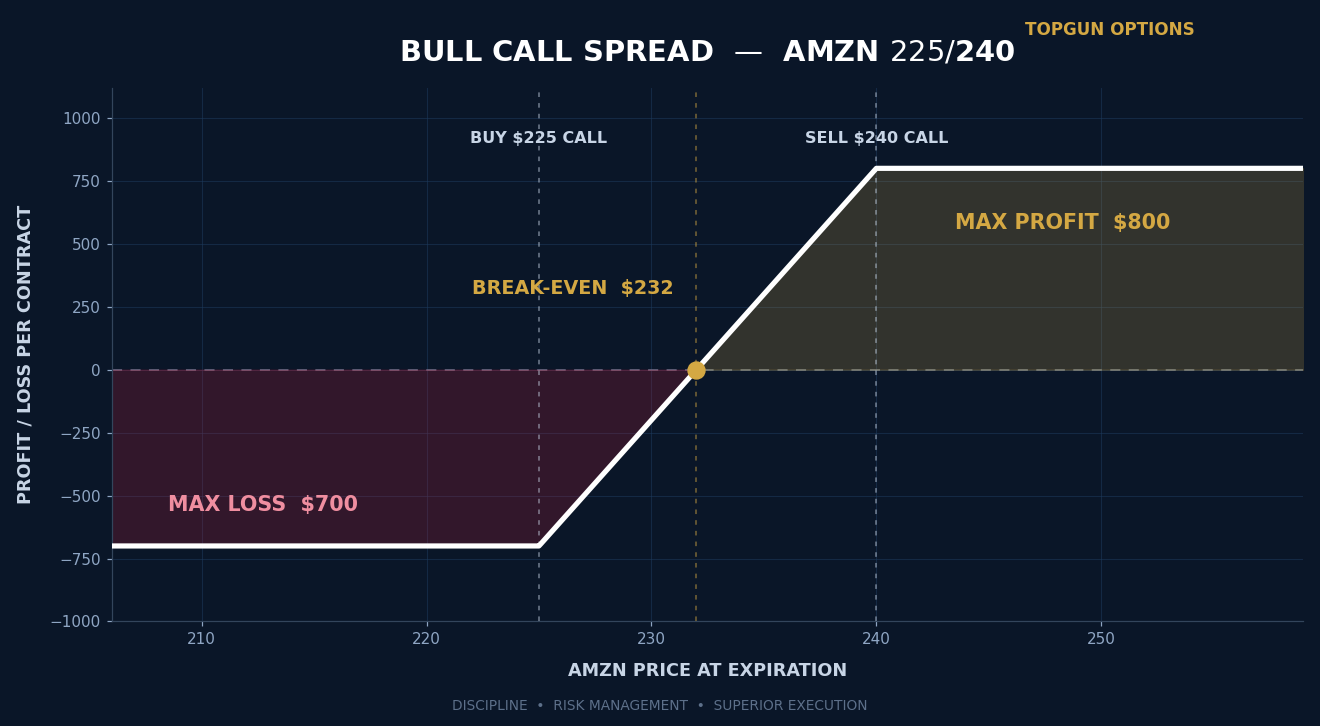
Notice what this diagram shows and a long call does not: both ends are flat. A bull call spread cannot surprise you in either direction. Every outcome lives between those two lines, and you knew both of them before you clicked buy.
The same structure scales out for years, not weeks. We published a bull call spread on the S&P 500 running all the way to December 2031 — the Bullish on ‘Merica SPX LEAPS alert, with the actual strikes, the debit paid and the break-even worked out. Same two legs as the example above. Same flat ends. The only thing that changed was the clock — see what LEAPS are for why the long-dated version behaves so differently.
When We Use A Bull Call Spread
This tactic earns its place when three things are true at once:
- You are bullish, but not unreasonably so. You have a price target. If your thesis is a runaway move to the moon, the short call is going to cost you.
- You want the cost down. The sold call typically takes a meaningful bite out of the debit, which lowers your break-even compared to buying the call outright.
- The risk-to-reward clears the minimum. We do not put a position on below 1:0.25 — you must be able to collect at least a quarter of what you are risking. The example above returns 114% on risk, so it clears comfortably.
Set the short strike at your actual target, not at the strike that makes the ticket cheap. The most common way traders wreck a bull call spread is picking S2 because it makes the debit look attractive, then watching the underlying blow through it. You did not get a bargain. You sold your thesis.
How We Actually Fund It
Here is where TOPGUN Options doctrine departs from what you will read elsewhere.
We rarely place a standalone debit spread. The house pattern is to run a credit spread that funds the debit spread. The credit side pays for the ticket; the debit side carries the upside.
Think about what that does. A bull call spread costs money the day you put it on — that is cash out of the account, decaying, needing the underlying to cooperate before you see anything back. Pair it with a credit position and the premium you collect covers all or part of that cost. Now you are carrying bullish exposure that the market largely paid for.
The credit side needs its own plan, its own risk-to-reward and its own management. It is a separate trade, not a discount coupon. But once you have run it a few times, paying full price for a naked bull call spread starts to feel like leaving money on the table.
Pairing a credit spread against a debit spread is the kind of thing that reads like theory and clicks the moment you watch it get built. Whiz runs two live trade briefs every week in Full Throttle — Primary Brief Tuesday, Accelerated Retirement Wednesday — placing real positions with real money while members watch the funding side get constructed alongside the upside.
Managing The Position
Taking profit
On a debit spread, at a 100% return we look to exit. In the example, a $7.00 debit trading around $14.00 has doubled. Take it off — or take 100% off, meaning close enough contracts to recover your original debit, and let the remainder ride to expiration. Once the original risk is off the table, what is left is house money.
Pigs get fat. Hogs get slaughtered. The last dollar of a spread is the slowest and most expensive one to collect.
This is where most training gets it wrong. You will read that you should set a stop at some percentage of the debit on a bull call spread. We do not.
Your max loss was defined the moment you entered. You already looked at $700 and decided you could absorb it. Ejecting at half of a loss you already accepted just converts a defined risk into a realised one, often right before the position recovers.
Exit if the Commit Criteria break — if the reason you entered is no longer true. Otherwise roll the bones and let it fly.
Pilot In Command → Trader In Command
Credit positions work differently. There, 2× the credit taken in is a flashing warning light in the cockpit — a decision point, not an exit order. You assess, then you hold, adjust or close. Deliberately.
Either way the principle is the same. The checklist does not fly the jet. You do. Every contingency gets briefed before the launch so that when something goes wrong, you are executing a decision you already made calmly instead of inventing one under pressure.
Bull Call Spread vs Long Call
| Bull Call Spread | Long Call | |
|---|---|---|
| Cost | Lower — the sold call offsets it | Full premium |
| Max profit | Capped at the short strike | Unlimited |
| Max loss | The debit | The premium |
| Break-even | Lower — you paid less | Higher |
| Time decay | Partially offset by the short leg | Works fully against you |
| Best when | You have a specific price target | You expect a large, fast move |
If you genuinely believe a name is about to run, buy the call. If you have a target and want the cost and the break-even down, use a bull call spread. Most bullish theses are the second kind, and most traders reach for the first.
How The Greeks Behave
- Delta: net positive. You want the underlying up.
- Theta: depends where price sits. Above the midpoint of the strikes, time decay works for you. Below it, against you.
- Vega: a rise in implied volatility helps while the bull call spread is out of the money and hurts once it is in the money. Two legs on opposite sides means volatility never hits you as hard as it would a naked long call.
Five Ways Traders Get This Wrong
- Picking the short strike for price instead of for a target. Cheap is not a thesis.
- Paying too much of the width. Paying $12 for a $15-wide bull call spread leaves $3 of upside against $12 of risk — nowhere near our 1:0.25 minimum.
- Treating it like a long call. Above the short strike you stop making money. Holding for a bigger move that the structure cannot pay you for is a plan built on a misunderstanding.
- Ejecting on a defined-risk position. You accepted the max loss at entry. Do not re-litigate it at the worst possible moment.
- Skipping the debrief. Win or lose, five minutes. The traders who skip it repeat the same mistake for years.
Keep Training
Full Throttle is where these tactics get placed live — two trade briefs a week, Whiz’s model and personal portfolios, and the Ready Room. You watch the strike selection and the management happen in real time, then go do it yourself.
Go Full Throttle Or Start With Tactical AlertsWhat side are you on?”
President, No Fallen Heroes Foundation | Founder, Sacred Warrior Fellowship


